All projects.
The work index.
2026Teach a Small Model to Reason with RL (GRPO on GSM8K)GRPO / GSM8K / PyTorch
Teach a Small Model to Reason with RL (GRPO on GSM8K)
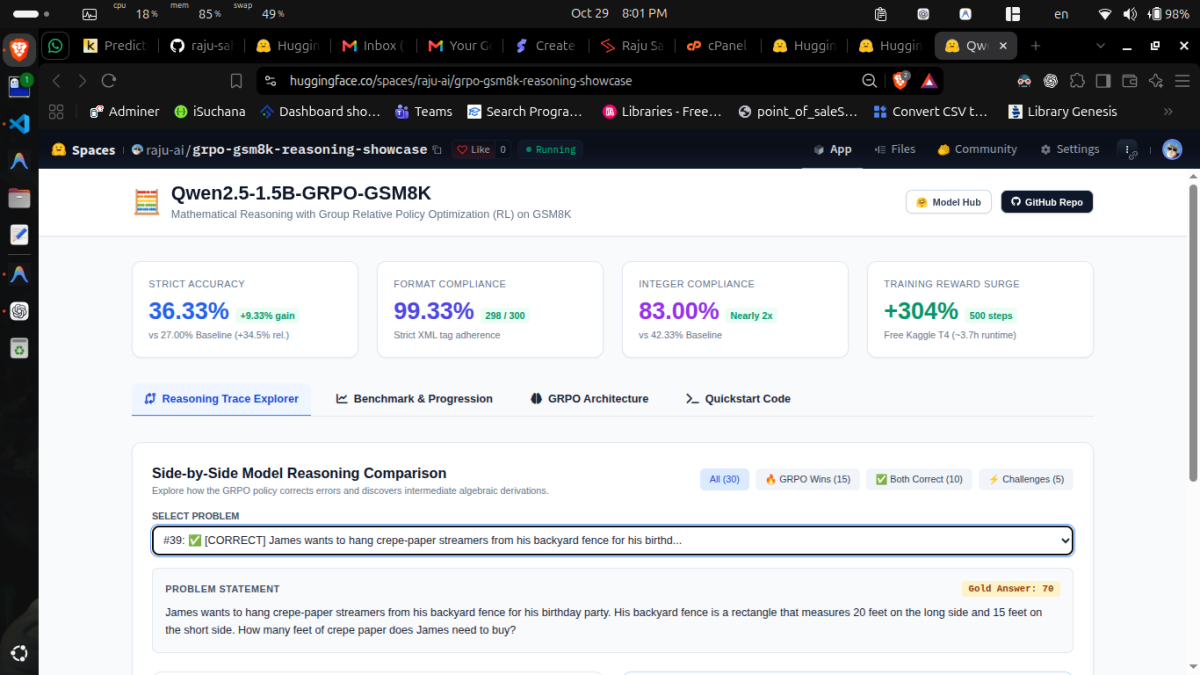
An AI model trained with reinforcement learning to solve grade-school math problems, explain its reasoning, and produce correctly formatted numerical answers.
Problem solved: Small language models can solve math problems but often produce inconsistent reasoning, malformed answers, or incorrect final numbers. Improving their reliability requires more than asking them to think step by step; the model needs to learn from feedback on its own attempts.
Solution: Built a reproducible reinforcement-learning pipeline using Group Relative Policy Optimization (GRPO), inspired by DeepSeek-R1. Fine-tuned Qwen2.5-1.5B-Instruct on the GSM8K math dataset using Unsloth, TRL, vLLM, and LoRA, with custom rewards for answer correctness, structured reasoning, and valid integer outputs. Trained for 500 steps on a free Kaggle T4 GPU and published the resulting adapter with an interactive demo.
Evaluation: Created a deterministic benchmark using 300 held-out GSM8K test questions, comparing the original model against the GRPO-trained model under greedy decoding. Measured strict answer accuracy, flexible accuracy, output-format compliance, integer compliance, and response length. Also tracked reward progression, training stability, and output quality throughout training.
Result: With the same reasoning prompt, strict answer accuracy improved from 27.00% to 36.33%, an absolute gain of 9.33 percentage points (34.5% relative improvement). Format compliance remained at 99.33%, while integer compliance increased from 42.33% to 83.00%. The experiment demonstrates how reinforcement learning can improve a small model's mathematical reasoning and answer formatting within a limited GPU budget.
2026Custom Trained AI To Create Mithila ArtPython / SDXL / LoRA
Custom Trained AI To Create Mithila Art
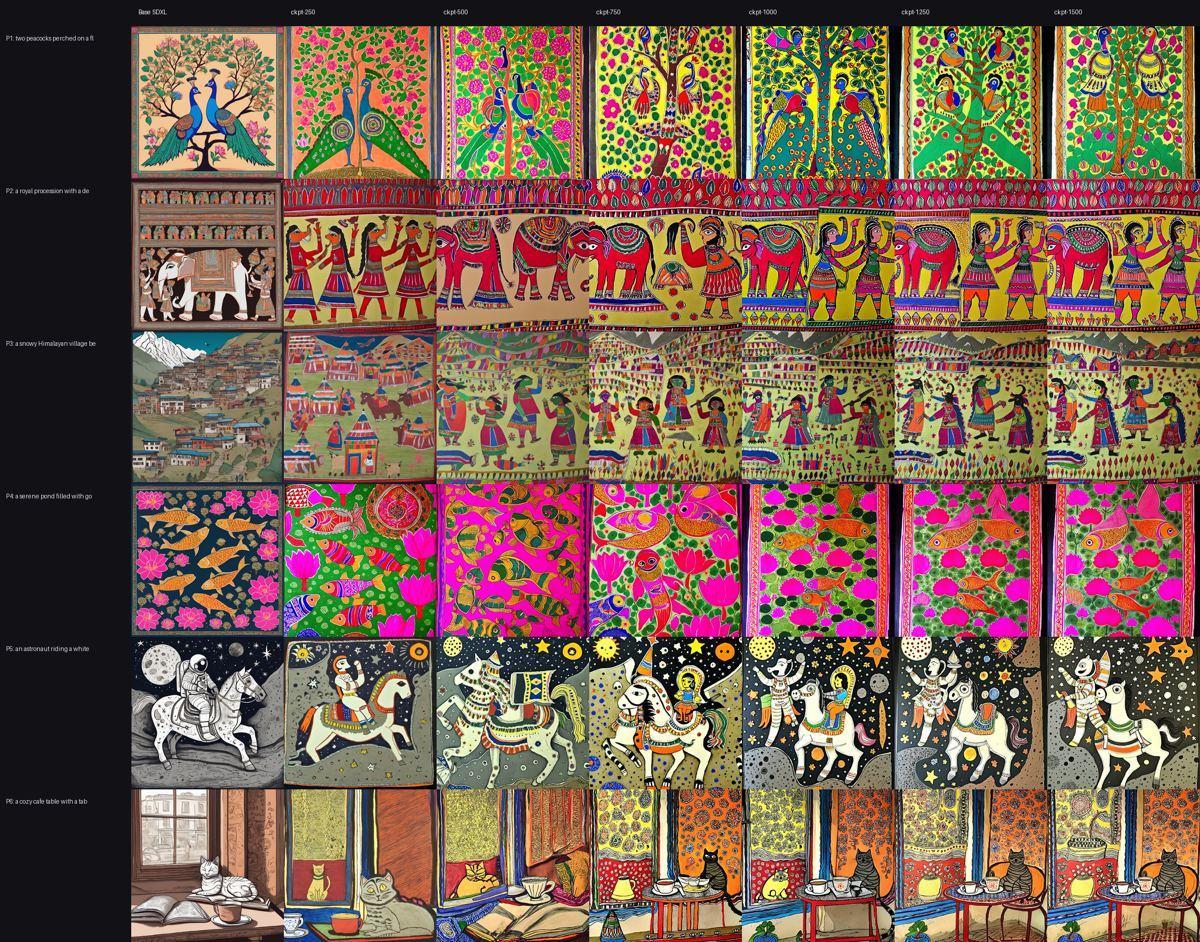
A tool that learns the traditional Mithila art style and generates new artwork from text prompts using a custom-trained AI model.
Problem solved: Adapting SDXL to a custom subject or visual style from a small image set can be expensive, difficult to reproduce, and easy to overfit. A usable workflow needs to choose a checkpoint that learns the intended style without simply memorizing training images or losing prompt control.
Solution: Built a reproducible SDXL LoRA training pipeline for 15–40 images on a free Kaggle T4. It prepares the dataset through crop, resize, deduplication, and captioning; trains with Diffusers DreamBooth-LoRA; renders fixed checkpoint-by-prompt comparison grids; and publishes the selected model through a Gradio demo.
Evaluation: Compared Base SDXL with checkpoints from 250 to 1,500 steps across six fixed prompts. Used CLIP for prompt adherence, DINOv2 style similarity against the Mithila dataset, and DINOv2 nearest-neighbor similarity to detect memorization, with a threshold below 0.88.
Result: Checkpoint 750 was selected: its DINOv2 style similarity reached 0.3949, a 111% improvement over the 0.1865 base-model baseline, while retaining a 0.2666 CLIP content score and a 0.6317 Max-NN score. Later checkpoints showed motif repetition and oversaturation, so this checkpoint gave the best balance for deployment.
2026AI Answers with Sources-RAG Citations EvalsPython / Streamlit / BM25
AI Answers with Sources-RAG Citations Evals
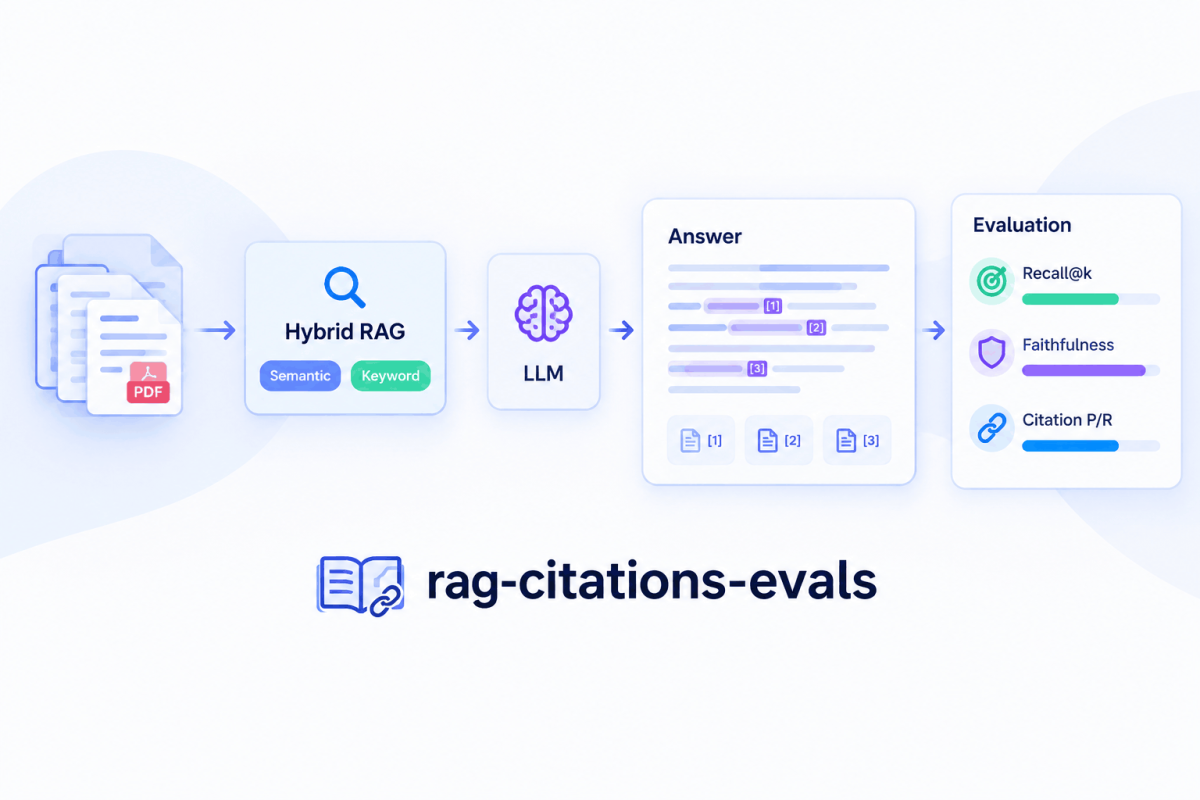
An AI tool that answers questions using documents and shows where its answers came from. It also tests how accurate and trustworthy those answers are.
Problem solved: Legal research assistants need to give people answers they can verify. A system can retrieve the wrong statute, lose section context, or mishandle Nepali queries; a fluent answer without source-level evidence is unsafe.
Solution: Built a hybrid RAG system for Nepal law that combines structure-aware chunking, BM25 and dense retrieval, reciprocal-rank fusion, cross-encoder reranking, and sentence-level [n] citations. It normalizes Devanagari numerals and routes Nepali queries through a legal glossary so cross-lingual searches retain their meaning.
Evaluation: Added a reproducible harness for Recall@5, MRR, nDCG@5, faithfulness, citation precision/recall, refusal rate, and latency, then compared retrieval, chunking, reranking, and prompting ablations on 1,712 chunks from 1,389 Nepal-law pages.
Result: The full pipeline reached 98.57% Recall@5, 0.9242 faithfulness, and 0.9804 / 0.9254 citation precision / recall. Structure-aware chunking and strict per-sentence citations delivered the largest gains in reliable, traceable answers.
2026Account System NepalJava 17 / Spring Boot 3 / Angular 15
Account System Nepal

AccountsNepal is a production web application for accounting, billing and inventory management, designed for businesses working across companies, branches and fiscal years in Nepal.
My contribution
I contributed across the Angular frontend and Spring Boot backend, and personally handled and obtained IRD verification for the production system.
Core workflows
- Accounting: double-entry bookkeeping, chart of accounts, journal entries, opening balances, customer receivables and supplier payables.
- Billing and POS: sales invoices, purchase bills, quotations, orders, credit and debit notes, receipts and payment vouchers.
- Inventory and delivery: products, batches, stock movements, stock valuation, split and merge operations, delivery chalans and branch transfers.
- Cash and banking: bank and wallet transactions, fund transfers, cheque tracking and reconciliation workflows.
- HR and payroll: employee records, attendance, leave, salary processing and payroll posting.
- Reporting: general ledger, trial balance, profit and loss, balance sheet, cash flow, stock reports and VAT sales and purchase registers.
- Nepal-specific workflows: Bikram Sambat and Gregorian date support, fiscal-year management, VAT handling and IRD/CBMS synchronization for sales bills and credit notes.
- Administration and exports: company and branch access, role-based permissions, audit logs, data migration, invoice printing and PDF/Excel exports.
2026potato disease detection and classificationPython / Numpy / FastApi
potato disease detection and classification
🥔 Precision Foliar Pathology & Deep Learning Architecture Suite
Multi-Architecture Neural Ensemble · Explainable AI (Grad-CAM) · Soft-Voting + Temperature Scaling T=0.7
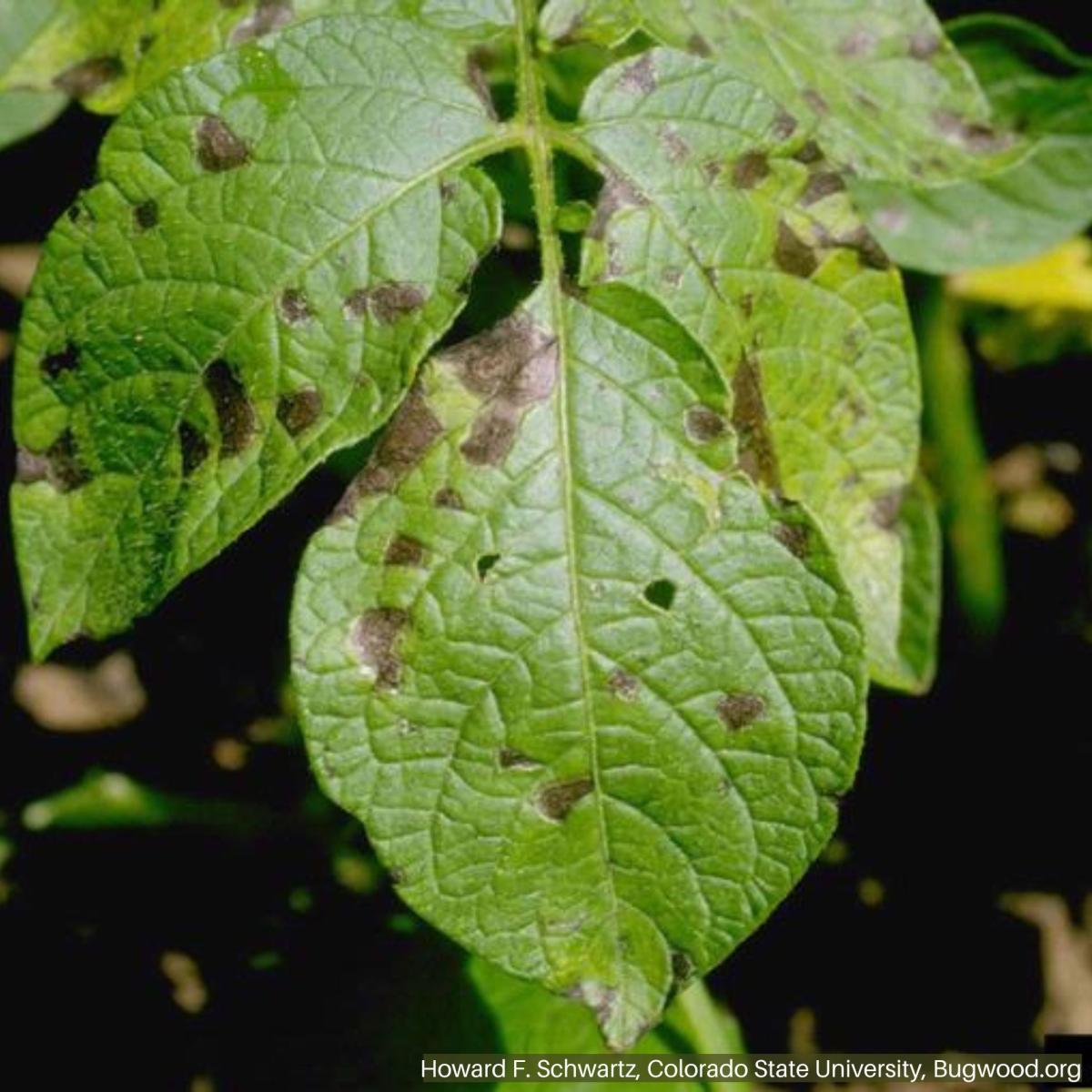
End-to-end foliar pathology suite for clinical diagnosis of potato leaf diseases (Alternaria solani — Early Blight, Phytophthora infestans — Late Blight, and Healthy). Moves beyond single-model prototypes with a Tri-Model Soft-Voting Ensemble (DenseNet-121 w0.45, ConvNeXt-Tiny w0.35, EfficientNetV2-S w0.20, 256×256) and Grad-CAM for transparent, field-ready decisions.
Research Benchmark & Ensemble
- DenseNet-121 / ConvNeXt-Tiny / EfficientNetV2-S — ImageNet-pretrained, fine-tuned, soft-voting + temperature scaling
- Kaggle GPU training, TFLite Float16 (21 MB) & Dynamic INT8 exports for edge/mobile
- ITT: TTA, label smoothing, class-weighted, EarlyStopping
Explainable AI
Grad-CAM saliency maps highlight lesion regions driving each prediction — essential for agronomist trust.
Results
Ensemble outperforms single backbones on 405-image held-out test via soft-voting + calibration. Prior B3 baseline: Test Acc 95.80% / Macro-F1 95.86. See Kaggle notebook for full ablation.
2026Real Time Face Recognitioninsightface's SCRFD / ArcFace recognition / onnxruntime (CPU)
Real Time Face Recognition

NeuroVision is a real-time face recognition system with live enrollment and instant multi-face identification. Users enroll by capturing guided multi-angle samples from their camera — no offline training, no static dataset required. The system learns new faces on the fly via face embeddings and identifies every person in the live camera feed simultaneously.
2026Iris Flower ClassificationDeep Learning ( TensorFlow 2.x, Keras, Mixed Precision (FP16) ) / ML Toolkit ( scikit-learn, NumPy, Pandas, Matplotlib, Seaborn ) / Grad-CAM
Iris Flower Classification

Sept 2025 - March 2026UTURN InternationalJava / SpringBoot / Angular
UTURN International

- Public Page ui design as well as backend apis.
- In distributor module, referral note, ticket, direct sales, promotional sales , month sales, area sales etc reports.
- In Admin module, distributor reports, sales center reports.
- Inventory management, User management features.
2026Cyber Bullying PredictionPandas / Numpy / NLTK
Cyber Bullying Prediction

Detects cyberbullying in Formspring Q&A posts using NLP and machine learning. Text is preprocessed (stopword removal, stemming) and vectorized with TF-IDF, then classified using multiple models with hyperparameter tuning via GridSearchCV.
Dataset
Formspring.csv -- 13,147 Q&A text entries from the Formspring social platform, labeled for cyberbullying presence.
2026Twitter Sentiment AnalysisNumPy / NLTK / FastAPI
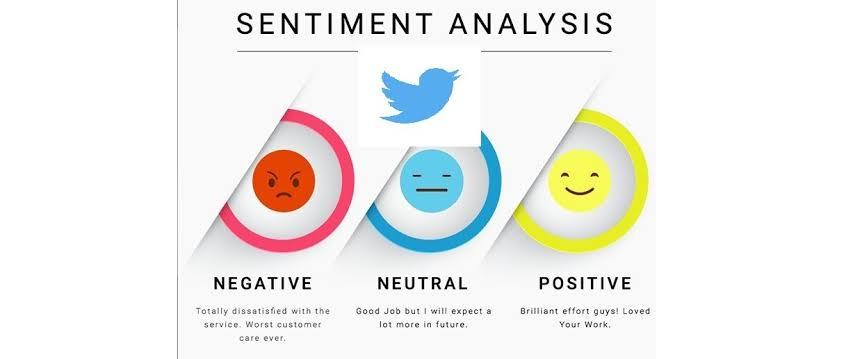
Twitter Sentiment Analysis
2026Message Spam FilteringPandas / NLTK / scikit-learn
Message Spam Filtering

Classifies SMS messages as spam or ham (not spam) using NLP preprocessing and machine learning. Text is cleaned by removing stopwords and applying stemming, then vectorized with TF-IDF. Multiple classifiers are trained and evaluated, including classical ML, neural networks with Word2Vec embeddings, and a fine-tuned DistilBERT transformer.
Oct 2025 - PresentOpiny Sponsor TippingJava / React / MySQL
Opiny Sponsor Tipping

- Perks with reports
- Tips with reports
- Payments with reports
- Referrals
- Support & Ticket.
- Settings
May 2024 – July 2025Edufinity – School Management SoftwareJava / PostgreSQL
Edufinity – School Management Software

- Complete student, teacher, and staff management system with role-based access.
- Class routine and academic scheduling modules.
- Events and academic calendar management.
- Automated invoice generation and fee management.
- Marksheet and academic report generation system.
- Bulk student and teacher upload using Excel files.
- REST API architecture for mobile app system integration.
May 2024 – Aug 2025Accounting SoftwareJava / PostgreSQL
Accounting Software

- Chart of Accounts, Sub Account.
- Sales, Purchase voucher creation with its payment.
- contra voucher.
- Ledger, Trial Balance, Profit & Loss reports etc.
- Payroll with salary generation and posting with its reports
Feb 2024 – April 2024Marvel TechnoplastJava / Mysql
Marvel Technoplast

- Hierarchical point distribution system.
- Multi-level role structure (Regional Manager, Area Sales Manager, Distributor, Retailer, Technician).
- Sales-based automated point allocation.
- Top-to-bottom hierarchy point flow logic.
- Point redemption and cash conversion system.
- Redemption payment processing.
- Payment approval workflow.
- Payment reporting system.
- Sales performance reward calculation.
Feb-6 2026 - Feb -7 2026Valentine Interactive Messenger – The “Love Link” FeatureLaravel / MySql / Javascript
Valentine Interactive Messenger – The “Love Link” Feature

- Valentine’s Week Calendar: Interactive calendar with a real-time Valentine’s Day countdown and automatic active-day highlighting.
- Personalized Love Links: Create unique, shareable links with custom messages and day-specific themes.
- Dynamic Receiver Experience: Private UUID-based links featuring romantic animations, love quotes, and date ideas.
- Real-time Interaction: Receivers can like, accept, or reject, while senders track opens, reactions, and timestamps live.
- Privacy-Focused: IP-based tracking ensures only the link creator can view analytics, with no login required.
Feb-16 2026 - Feb -18 2026RajuGPT ChatbotOpenRouter / FireCrawl / smalot/pdfparser
RajuGPT Chatbot

🤖 RajuGPT is a context-aware RAG chatbot built with Laravel and OpenRouter, supporting models like Grok-4.1 Fast, GPT-4o, and Gemini 1.5 Pro. It uses hybrid search (MySQL Full-Text + vector embeddings with cosine similarity) for accurate retrieval, maintains conversation memory with Laravel Sessions and localStorage, and automatically ingests knowledge from websites (Firecrawl), PDFs, and GitHub repositories.
No projects match your search. Try a different project or technology.