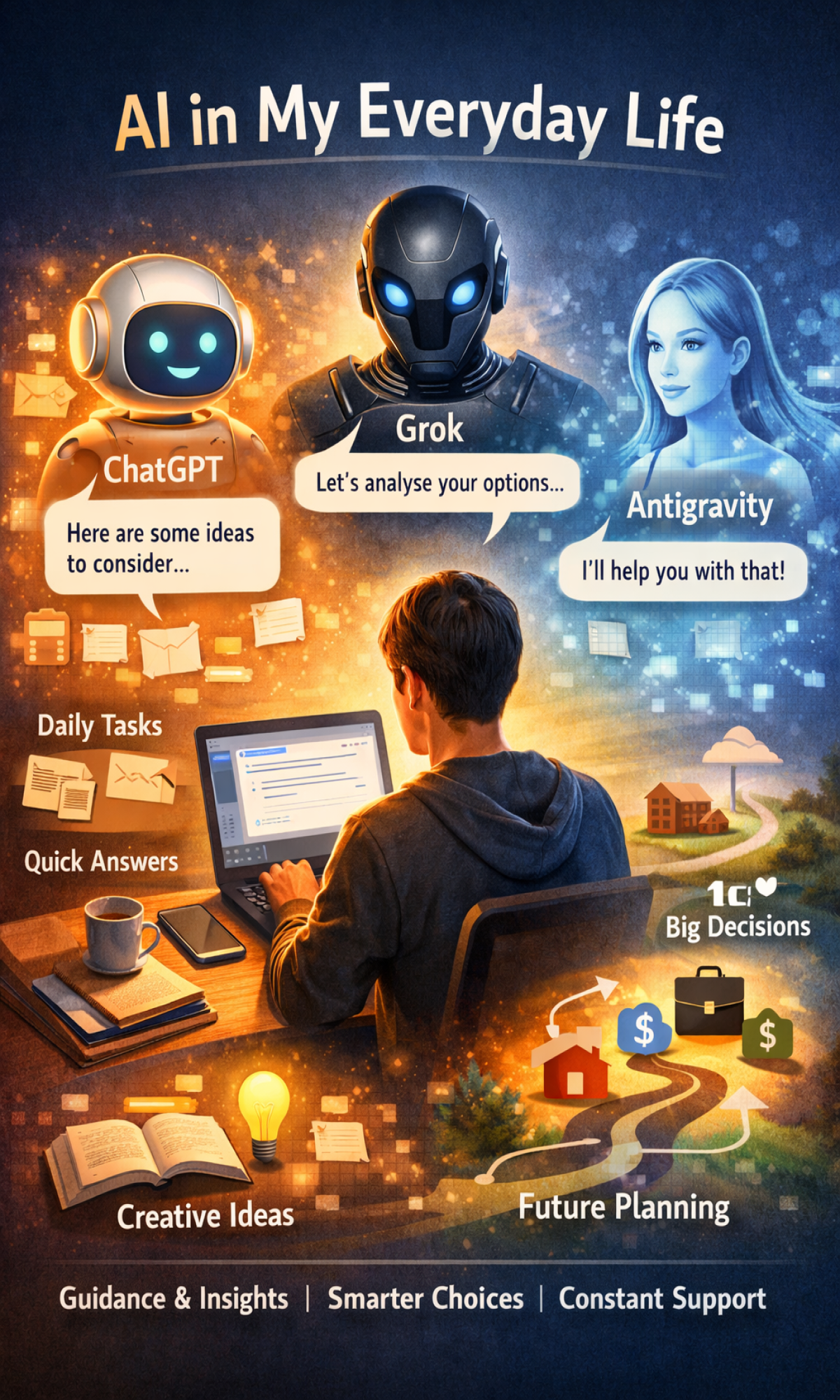
How AI Became My Everyday Companion
Artificial intelligence has quietly become a part of my daily life. Tools like ChatGPT, Grok, and Antigravity are no longer just technologies I experiment with. They’ve become assistants, sounding boards, and decision partners.From the smallest daily details to major life decisions, I rely on AI to think more clearly and act more confidently.
On a simple day, AI helps me draft messages, fix code errors, refine ideas, and organize my schedule. When I’m stuck on a technical issue or exploring a new concept, I can break it down instantly with clear explanations. Instead of spending hours searching for scattered answers, I get structured guidance in seconds.
For creative tasks, AI helps me write better, brainstorm smarter, and express ideas more effectively. It turns rough thoughts into refined output. It challenges my assumptions and sometimes offers perspectives I would not have considered on my own.
But the impact goes beyond productivity.
When I face bigger decisions, whether career-related, financial, or personal, I use AI as a thinking partner. I lay out options, explore pros and cons, simulate outcomes, and clarify what truly matters. It doesn’t decide for me, but it sharpens my thinking and reduces emotional bias.
What makes this powerful is consistency. AI is available anytime, never tired, never distracted. It remembers context, adapts to my style, and evolves with my needs.
In many ways, AI has become an extension of how I think. It amplifies my curiosity, accelerates my learning, and supports my growth. From everyday tasks to life-changing decisions, it plays a steady role in shaping how I move forward.
Technology once felt like a tool. Now, it feels like a companion in progress.
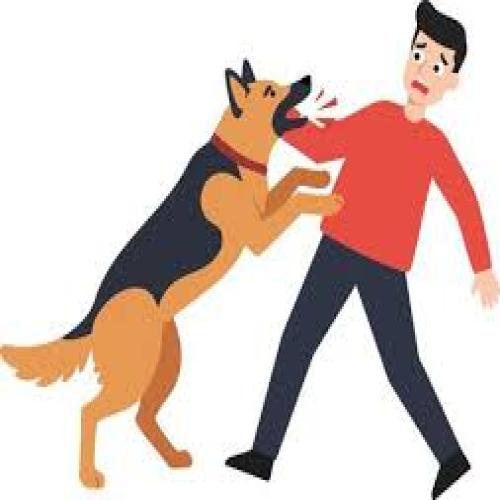
The Dog Love Bites...
They say some people have a face that dogs just can’t resist… apparently mine screams “free love bites, apply here!”
The first time was back in Grade 3. I was minding my own business, probably trying to look cool while walking home with my school bag bigger than me. Out of nowhere, this neighborhood dog decided I needed a dramatic introduction. Chomp! Right on the leg. I yelped louder than the school bell, tears instant, shock level 100. The pain was real, the fear was bigger, and the tetanus shot + injections that followed felt like the dog sent his cousins to finish the job at the clinic.
Fast-forward to February 2026 (yes, adult me, supposedly wiser). I’m just strolling in Kathmandu, feeling like a responsible grown-up. Then another dog—different one, same energy—goes full rom-com on me. One second I’m thinking about momo for dinner, the next I’m starring in my own action scene: “Argh! Not again!” Same shock, same alarm, same immediate rush to get cleaned, vaccinated, and lectured by the doctor about “stray dog awareness.” As an adult, the fear is quieter, but the “why me?” is louder.
Look, I don’t know what perfume I’m wearing that smells like “prime bite real estate,” but clearly I’m on some dogs’ VIP love-bite list. Twice in one lifetime? That’s not coincidence; that’s destiny with teeth.
Both times hurt like crazy, both times sent me straight to the hospital and both times reminded me: dogs may see me as their personal chew toy.
Next time a dog looks at me a little too long, I’m just gonna smile and whisper, “Bro, we’ve got to stop meeting like this.” 😅
(And if it happens a third time… I’m officially changing my name to “No More Bites Raju.”)
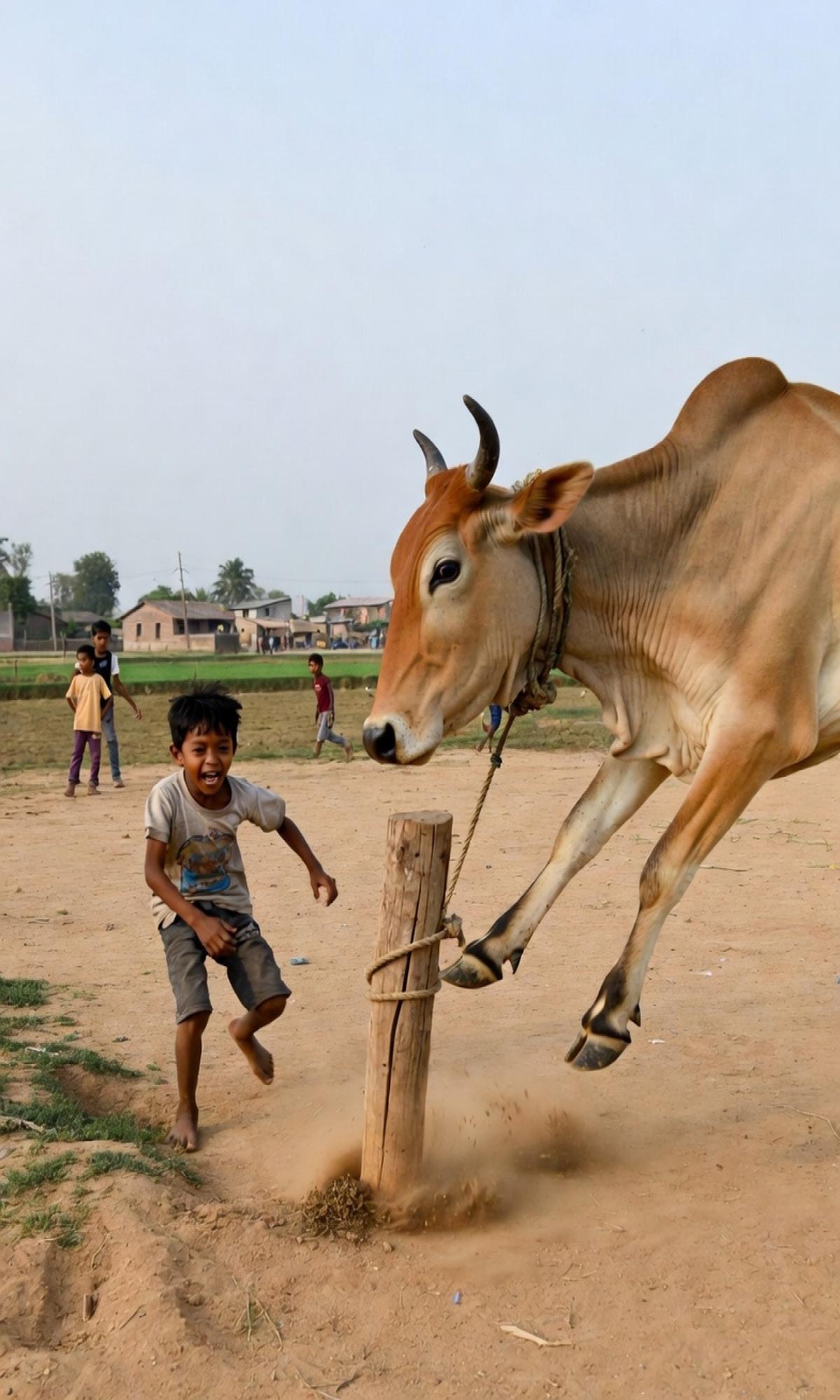
The Day a Wooden Peg Saved My Life
One sunny afternoon in Grade 6, my friends and I were playing on the open ground near the village fields—running, laughing, kicking a worn-out ball. A big cow grazed quietly at the edge, tied to a wooden peg with a rope. We barely noticed her.
Suddenly she snorted, lowered her horns, and charged. My friends scattered, leaping fences and trees. I turned to run but tripped on a root and fell flat. The cow thundered toward me—dust flying, hooves pounding. I lay frozen, heart slamming, certain this was the end.
She was almost on me when her hoof caught the wooden peg. The rope jerked tight, twisting her sideways. She stumbled, lost balance, and veered off, dragging the peg behind her.
I stayed on the ground, shaking, tears in the dust. My friends pulled me up. No injuries, but the fear stayed deep.
I still believe it wasn’t just luck—the peg, my mother’s morning prayers, something watching over me. That moment taught me how thin the line between life and danger can be.
When disaster misses you by inches, carry quiet gratitude. A simple rope or blessing can be stronger than fear. Hug those who pray for you, and never forget: the smallest thing can save everything.
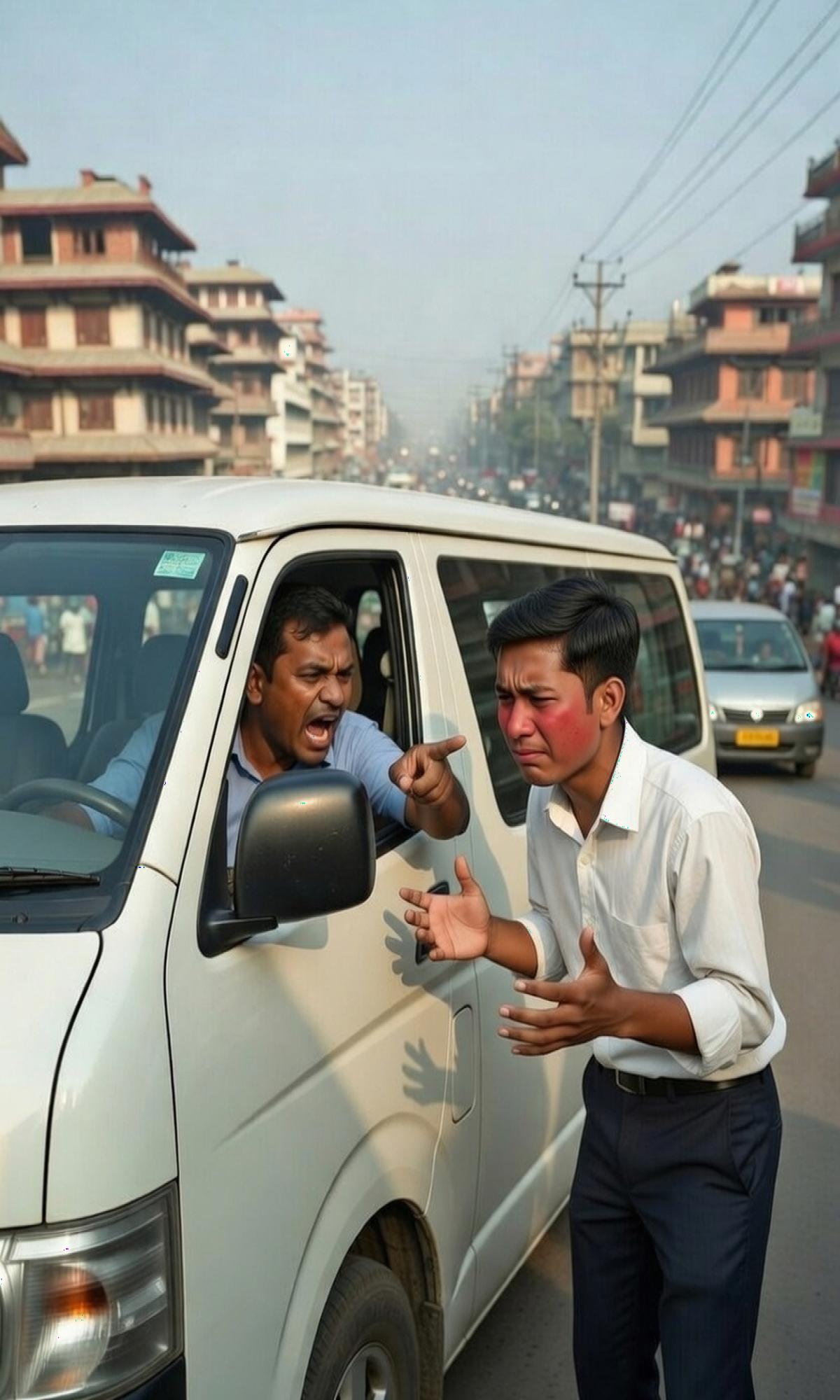
Internship Days, Empty Pockets, and a Lesson I"ll Never Forget
It was just another typical struggle during my internship days in Kathmandu — earning only Rs. 5,000 a month, scraping by on the bare minimum, counting every rupee like it was gold. To save a few bucks on my daily commute from Kirtipur to Balkhu, I started using a fake BBA student ID card for the student discount on the bus. It felt like a harmless shortcut at first — many people did it, and the discount (around 45% back then) made the short ride feel a little less painful on my tight budget.
One day, the bus driver got suspicious. He took a long look at the ID, then turned to me with a straight face and asked, “Okay, tell me the subjects you're studying in your current semester for BBA.” My mind went completely blank. I stammered, tried to recall something generic like “English” or “accounting,” but nothing specific came out — no Business Mathematics, no Fundamentals of Marketing, no Microeconomics for Business, nothing from the actual Tribhuvan University syllabus. The driver just shook his head, kept the fake ID without a word, and made me pay the full fare. No shouting, no drama — just quiet disappointment in his eyes that hit harder than any argument.
I got off at Balkhu feeling a wave of embarrassment and shame wash over me. My face burned the whole walk home. It wasn't just about the money I'd lost or the ID I'd thrown away; it was the realization that I'd crossed a line for something so small. In that moment, trying to save Rs. 10–20 felt like the biggest mistake I'd made in a long time.
From that day on, I swore off fake IDs forever. No more shortcuts that compromise honesty, even when finances are tight. I started budgeting better, walking extra distances when I could, and reminding myself that integrity isn't something you bargain away — it's the one thing that stays with you long after the paycheck runs out.
Life lesson: Financial struggles are real, especially on a Rs. 5,000 internship stipend, but a moment of dishonesty can cost you far more in self-respect than any discount could ever save. Choose honesty — it's the only fare that always gets you where you need to go, with your head held high.
From Discount to Dignity: A Short Ride That Went the Distance
It was just another typical Nepali journey home — the kind you’ve done a hundred times. I showed up at Kalanki, skipped the ticket counter, jumped onto a Siraha-bound bus, and immediately started bargaining with the conductor while the bus was already crawling through traffic. Full price at the counter was Rs. 1200, but after some back-and-forth (“Dai, discount dinu na, 20%? 25%? 30%?”), I managed to lock in Rs. 1000. Felt like a small win — saved Rs. 200(enough for a hearty dal-bhat dinner on the way) before we even left the Kathmandu valley chaos.
The bus hadn’t gone far — maybe 3–4 km, still stuck somewhere near the ring road — when my older brother called. “Don’t come home right now, bhai. Some family matter has come up. Just wait or turn back.” Classic last-minute Nepali plot twist. I told the conductor calmly, “Dai, malai yaha rokera jana parchha. Rs. 300 dinchu, distance anusar.” That was honestly generous; for such a short ride, the fair share should have been barely Rs. 20–30. But he wasn’t having it.
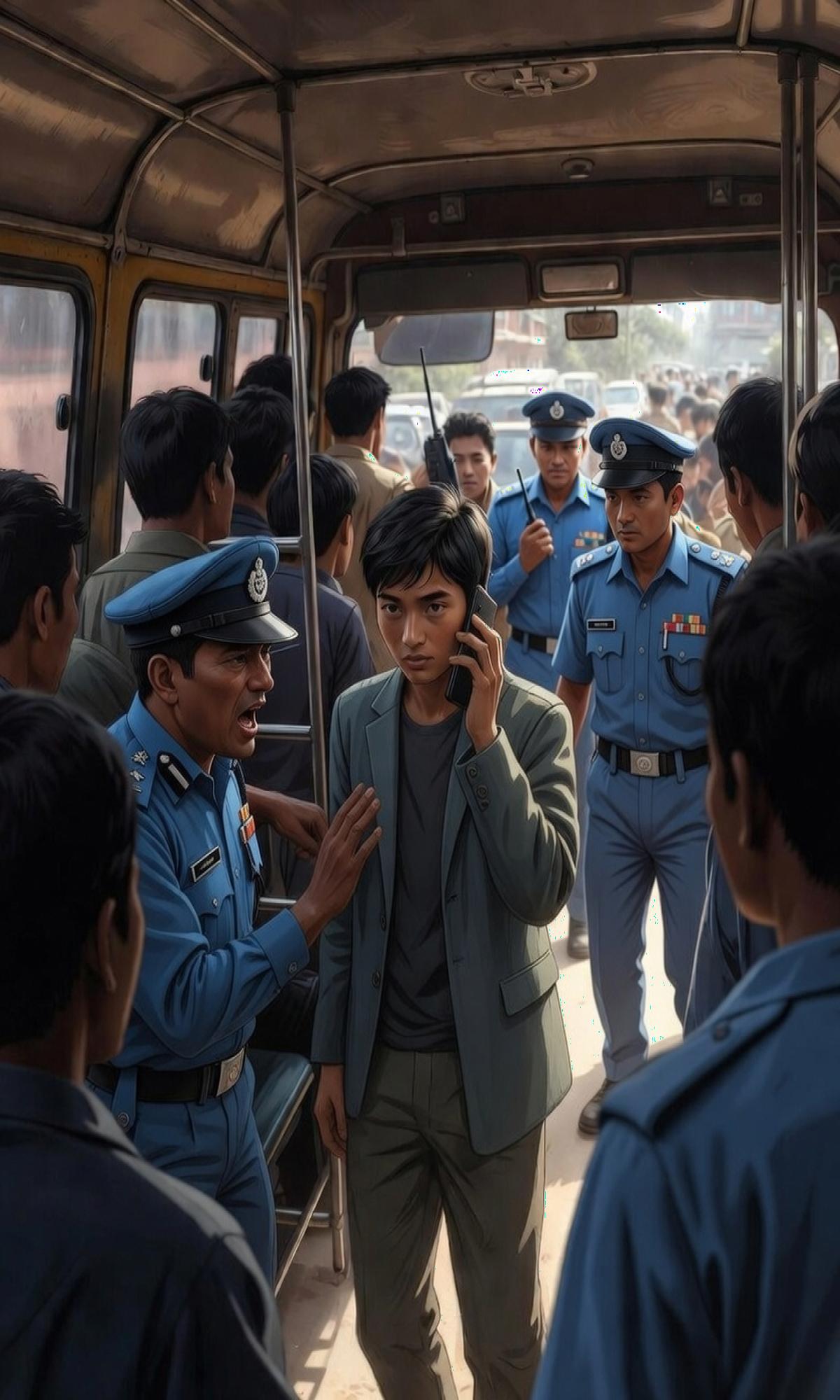
His tone changed instantly. No more friendly “dai” vibe. He puffed up, raised his voice, and insisted on the full Rs. 1000. “Discount diyeko ho, aba kata jane? Full paisa dinu parchha! Police aayo bhane ni kehi hudaina!” It wasn’t about the money anymore; it felt like a power play, like he enjoyed watching passengers squirm. I stood there in the aisle, bag in hand, feeling small in that packed bus, but something inside refused to fold.
I took a slow breath, pulled out my phone, and dialed the police helpline. I explained everything clearly: the bargain, the short distance, the demand for full fare, the threats. To my surprise, a patrol actually arrived within minutes. The moment the officers stepped onto the bus, the conductor’s entire attitude collapsed. The loud, intimidating man suddenly became the quietest person on board — zero arguments, zero eye contact. The police listened, asked a couple of questions, and told me I could get off without paying anything extra. I stepped down, walked away, and for once the Rs. 1000 “deal” didn’t feel like a loss.
That short ride taught me a longer lesson: In Nepal, bargaining can get you a cheaper ticket, but real strength comes from refusing to be bullied when someone tries to take advantage. A phone call, a calm explanation, and the willingness to stand your ground — even when you’re alone in a crowded bus — can flip the script faster than you expect. Sometimes the best discount isn’t on the fare; it’s on your dignity, and it costs nothing but a bit of courage.